
In the world of health, wellness, and performance optimization, the terminology can often become confusing. Two terms that are frequently mentioned in the same breath — yet represent entirely different classes of compounds — are peptides and steroids. Because both are utilized by athletes, bodybuilders, and anti-aging enthusiasts to enhance physical performance and recovery, a common question arises: Are peptides steroids?
The short and definitive answer is no. Peptides and steroids are fundamentally different in their chemical structure, their mechanism of action within the human body, their side effects, and their legal status. While anabolic steroids are synthetic derivatives of testosterone designed to force muscle growth, peptides are short chains of amino acids that act as signaling molecules, prompting the body to optimize its own natural processes.
This comprehensive guide will explore the scientific distinctions between peptides and steroids, how each compound interacts with the body, the specific benefits of research peptides, and why an increasing number of researchers and wellness advocates are turning to peptides as a safer, more targeted alternative.
What Are Peptides? The Biological Messengers
To understand why peptides are not steroids, we must first define what a peptide actually is. At a molecular level, a peptide is a short chain of amino acids linked together by peptide bonds. Amino acids are the fundamental building blocks of life; when long chains of amino acids fold into complex three-dimensional structures, they become proteins. Peptides are simply smaller versions of proteins, typically consisting of anywhere from 2 to 50 amino acids.
Because of their small size, peptides are easily absorbed and utilized by the body. More importantly, peptides function as highly specific signaling molecules. They bind to receptors on the surface of cells and deliver specific instructions, telling the cell to perform a particular function.
For example, some peptides signal the pituitary gland to release more natural growth hormone. Others signal the body to accelerate angiogenesis — the formation of new blood vessels — to heal damaged tissue. Because they are naturally occurring or mimic naturally occurring sequences, the body recognizes them and responds to them efficiently.
Common Categories of Research Peptides
The versatility of peptides means they can be engineered or isolated to target very specific biological outcomes. Researchers typically categorize peptides based on their primary function:
Growth Hormone Secretagogues (GHS) stimulate the body’s natural production and release of growth hormone. Unlike synthetic Human Growth Hormone (HGH) injections, which shut down the body’s natural production, GHS peptides encourage the body to produce its own. Healing and recovery peptides are compounds designed to accelerate tissue repair, reduce inflammation, and heal tendons, ligaments, and muscle tissue. Metabolic and weight loss peptides influence fat metabolism, blood sugar regulation, and appetite. Finally, cognitive and anti-aging peptides protect neural pathways, improve sleep architecture, and regulate cellular aging.
For researchers looking to explore these categories, Bio Apex Express offers a comprehensive catalog of rigorously tested peptides, ensuring 99.5%+ HPLC purity for accurate laboratory results.
What Are Steroids? The Hormonal Overriders
When people ask if peptides are steroids, they are almost always referring to anabolic-androgenic steroids (AAS). Anabolic steroids are synthetic, laboratory-created variations of the male sex hormone testosterone.
The term “anabolic” refers to muscle building, while “androgenic” refers to the development of male sexual characteristics. Steroids work by entering the muscle cell, binding directly to the androgen receptor, and interacting with the cell’s DNA to dramatically increase protein synthesis.
Unlike peptides, which gently signal the body to optimize its natural functions, anabolic steroids forcefully override the body’s endocrine system. By introducing massive amounts of exogenous (external) hormones, steroids command the body to build muscle at an unnatural rate.
The Endocrine Disruption of Steroids
The human body operates on a delicate feedback loop known as homeostasis. When a person injects anabolic steroids, the brain detects the massive surplus of testosterone in the bloodstream. In response, the brain signals the testes to completely shut down their natural production of testosterone.
This shutdown leads to a cascade of severe side effects, including testicular atrophy, infertility, severe mood swings, cardiovascular strain, liver toxicity, and the potential for gynecomastia — the development of breast tissue in men due to excess testosterone converting into estrogen. When a steroid cycle ends, the user is left with a suppressed endocrine system, requiring extensive post-cycle therapy (PCT) to attempt to restart natural hormone production.
Peptides vs. Steroids: A Head-to-Head Comparison
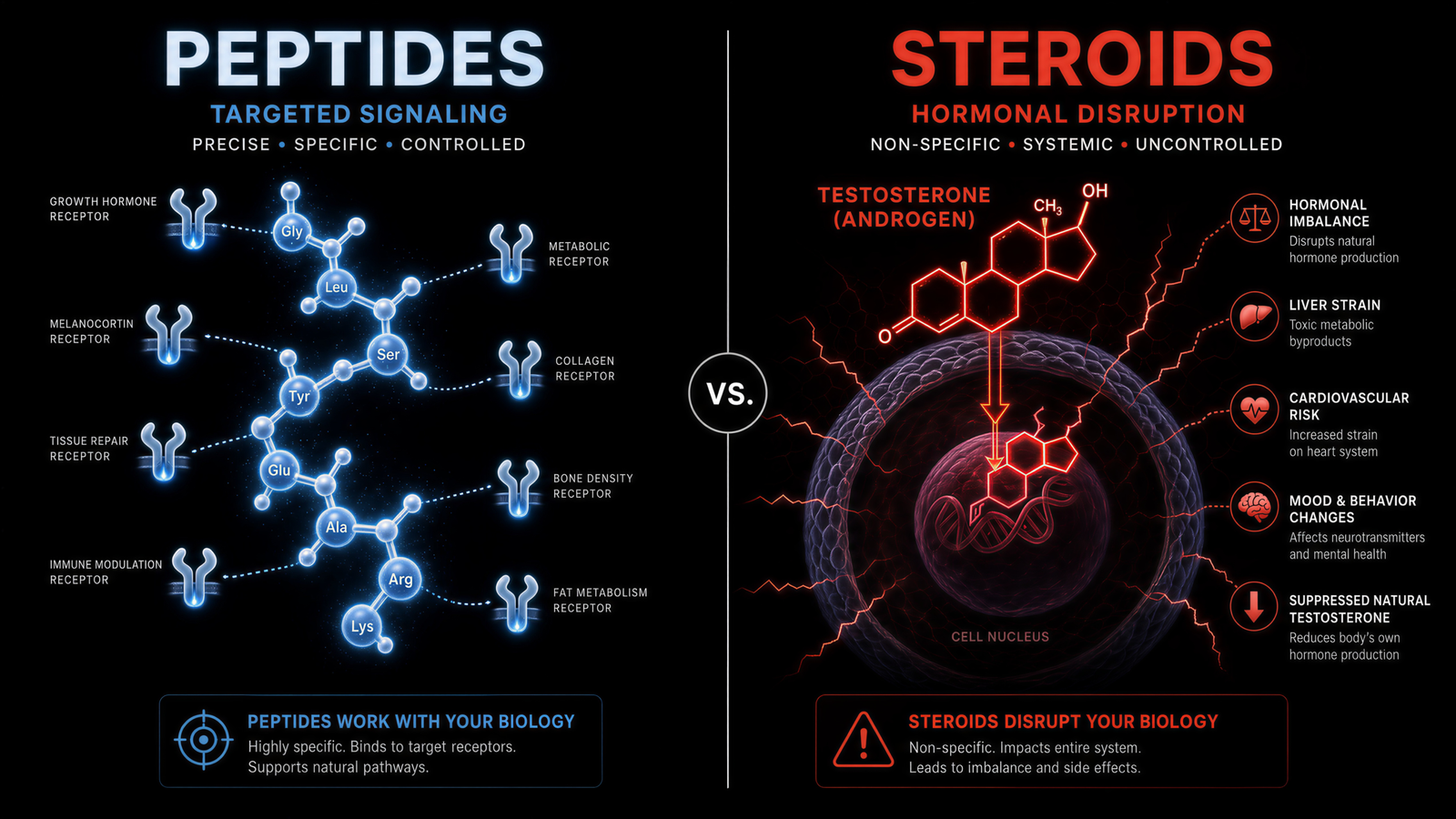 Peptides act as precise biological messengers; steroids forcefully override the body’s hormonal system.
To clearly illustrate why peptides are not steroids, we can compare them across several critical dimensions: chemical structure, mechanism of action, target specificity, and side effect profiles.
| Feature | Peptides | Anabolic Steroids |
|---|---|---|
| Chemical Structure | Short chains of amino acids (building blocks of proteins) | Synthetic derivatives of cholesterol/testosterone (lipids) |
| Mechanism of Action | Bind to cell surface receptors to trigger natural processes | Enter the cell nucleus to directly alter DNA transcription |
| Endocrine Impact | Stimulates natural hormone production; no suppression | Overrides and suppresses the body’s natural hormone production |
| Target Specificity | Highly targeted — specific peptides trigger specific responses | Systemic — affects the entire body, including organs and the cardiovascular system |
| Side Effect Profile | Generally mild and transient | Severe and systemic: liver toxicity, cardiovascular disease, endocrine shutdown |
| Post Cycle Therapy | Not required | Absolutely mandatory to restore natural testosterone production |
Why Athletes and Researchers Are Shifting to Peptides
For decades, anabolic steroids were the primary tool for athletes seeking to push past their genetic limits. However, as the severe long-term health consequences of steroid abuse became undeniable, the scientific and athletic communities began searching for safer, more sustainable alternatives. This search led to the rise of peptide therapy.
Peptides offer a paradigm shift in how we approach physical enhancement and recovery. Instead of using a sledgehammer to force the body to grow, peptides act as a scalpel — precisely tuning the body’s natural machinery.
1. Targeted Tissue Healing: The BPC-157 Advantage

One of the most significant limitations of anabolic steroids is that while they rapidly increase muscle mass, they do not strengthen tendons and ligaments at the same rate. This disparity frequently leads to severe connective tissue tears in steroid users.
Peptides, conversely, excel at connective tissue repair. A prime example is BPC-157 (Body Protection Compound 157). Derived from a protein found in human gastric juice, BPC-157 is renowned in research circles for its ability to dramatically accelerate the healing of tendons, ligaments, and muscle tissue by promoting angiogenesis.
Unlike a steroid, which simply masks pain or forces muscle growth, BPC-157 signals the body to physically rebuild the damaged tissue. Researchers studying tissue recovery frequently utilize BPC-157 (10mg) or the highly synergistic BPC-157 + TB-500 Wolverine Stack to observe accelerated healing protocols.
2. Natural Growth Hormone Optimization
Many individuals seek out steroids to achieve the fat loss and muscle preservation associated with high levels of growth hormone. However, injecting synthetic Human Growth Hormone (HGH) carries risks similar to steroids, including the suppression of natural pituitary function.
Peptides known as Growth Hormone Secretagogues — such as Ipamorelin, CJC-1295, and Tesamorelin — offer a safer alternative. These peptides signal the pituitary gland to release its own stored growth hormone in a natural, pulsatile manner. Because the body is producing the hormone itself, the negative feedback loop is not triggered, and natural production is not suppressed. This results in improved sleep, enhanced fat loss, and better recovery without the endocrine disruption of steroids.
3. Metabolic Regulation and Weight Loss
Steroids are notoriously poor at directly burning fat; their primary function is tissue accretion. Peptides, however, can be engineered to specifically target metabolic pathways.
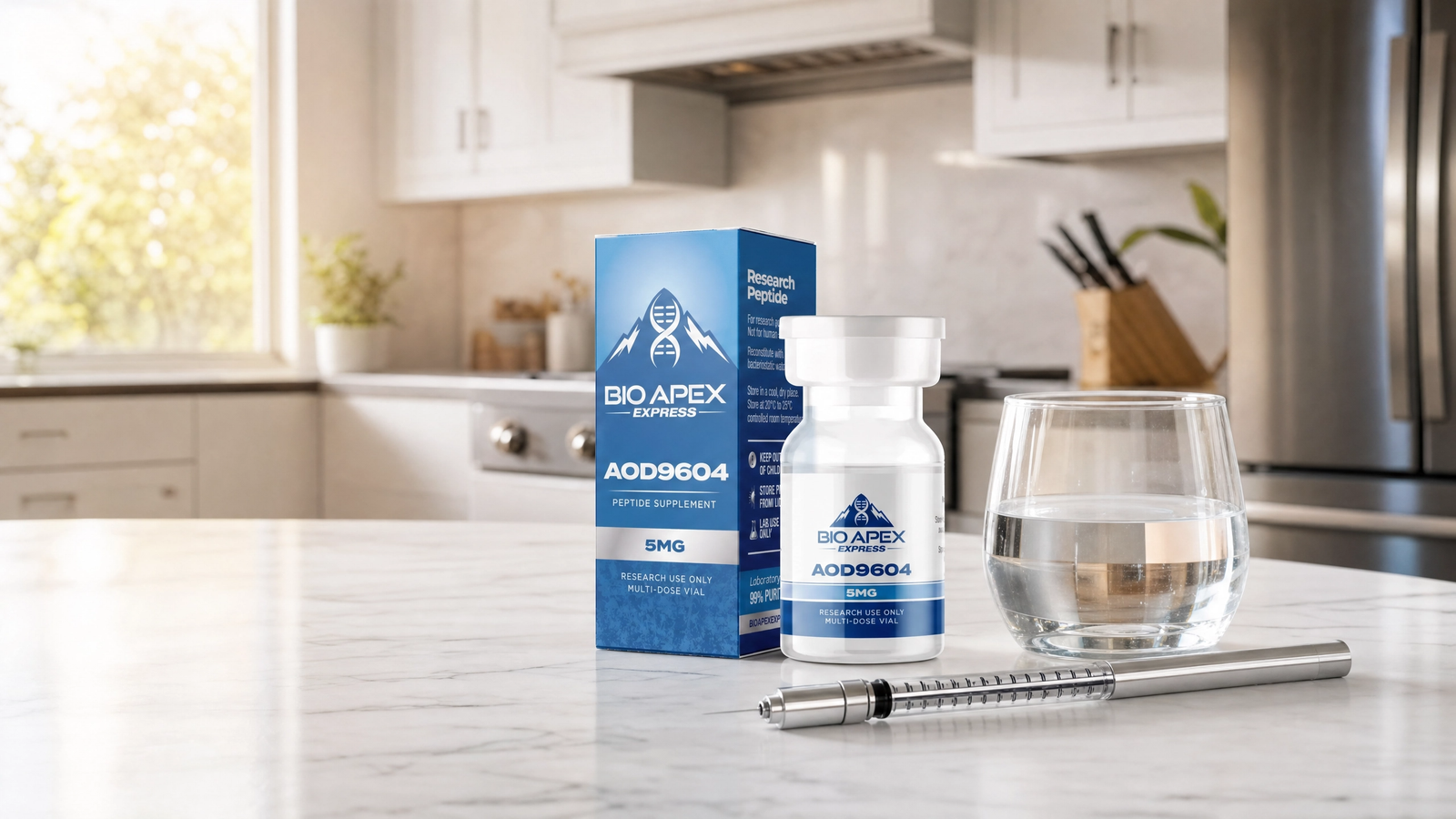
AOD 9604 is a peptide fragment derived from the C-terminus of human growth hormone. Research indicates that it stimulates lipolysis — the breakdown of fat — and inhibits lipogenesis without affecting blood sugar levels or tissue growth. Researchers studying targeted fat reduction often source high-purity AOD 9604 Peptide 10MG to observe these metabolic effects without the systemic risks of hormonal drugs.
Similarly, advanced metabolic compounds like Retatrutide and Mazdutide are revolutionizing the study of weight loss and metabolic syndrome by acting on multiple incretin receptors simultaneously — a mechanism entirely distinct from anything a steroid can achieve.
The Safety Profile: Peptides vs. Steroids
When evaluating any compound, the risk-to-reward ratio is paramount. The safety profile of peptides is vastly superior to that of anabolic steroids, primarily due to their mechanism of action.
Because peptides are composed of amino acids — the same molecules found in dietary protein — the body possesses the natural enzymes required to break them down and metabolize them safely. They do not place undue stress on the liver or kidneys, which is a hallmark danger of oral anabolic steroids.
Furthermore, because peptides act as signaling molecules rather than hormonal replacements, they do not cause the masculinizing side effects seen in women who use steroids (such as voice deepening or facial hair growth), nor do they cause the feminizing side effects seen in men (such as gynecomastia).
While peptides are generally well-tolerated in research settings, they are not entirely without side effects. Depending on the specific peptide, subjects may experience temporary redness at the injection site, mild water retention, increased hunger (specifically with GHRP-6 or GHRP-2), or temporary flushing. However, these effects are transient and cease when the peptide administration is stopped — unlike the permanent organ damage associated with long-term steroid abuse.
The Importance of Purity in Peptide Research
While peptides are inherently safer than steroids, their safety and efficacy are entirely dependent on their purity. The peptide market is, unfortunately, plagued by low-quality, underdosed, or contaminated products sourced from unverified laboratories.
Injecting a degraded or contaminated peptide can lead to severe immune responses, infections, or entirely skewed research data. This is why serious researchers demand strict third-party verification.
At Bio Apex Express, every single batch of synthesized peptides undergoes rigorous High-Performance Liquid Chromatography (HPLC) and Mass Spectrometry testing. This ensures a minimum purity of 99.5%+, guaranteeing that researchers receive exactly the molecular sequence they require, free from harmful binders or heavy metals. Whether you are studying the neuroprotective effects of Cerebrosylin or the cellular recovery properties of Epithalon, verified purity is the foundation of safe and accurate research.
Frequently Asked Questions: Peptides vs. Steroids
1. Are peptides legal?
Research peptides occupy a different regulatory category than anabolic steroids. In most jurisdictions, research peptides are legal to purchase for laboratory and research purposes. Anabolic steroids, by contrast, are classified as controlled substances in Canada, the United States, and most of Europe.
2. Do peptides cause hormonal suppression like steroids? No. This is one of the most important distinctions. Peptides that stimulate growth hormone release (GHS peptides) work by signaling the pituitary gland to release its own stored growth hormone. They do not introduce exogenous hormones, so the body’s natural feedback loop remains intact, and no suppression occurs.
3. Can peptides build muscle like steroids? Peptides can support muscle growth indirectly — primarily through optimizing growth hormone levels, accelerating recovery, and improving sleep quality. However, they do not produce the rapid, dramatic muscle gains associated with anabolic steroids. This is both a limitation and a feature: the gains supported by peptides are more sustainable and come without the severe side effects.
4. What is the best peptide for tissue healing? BPC-157 and TB-500 are the most widely studied peptides for tissue healing in research settings. The BPC-157 + TB-500 Wolverine Stack combines both compounds for synergistic recovery research.
Are Peptides Steroids? A Clear Distinction
To return to the original question: Are peptides steroids?
Absolutely not.
Anabolic steroids are synthetic hormones that forcefully override the body’s endocrine system, commanding unnatural muscle growth at the cost of severe, often permanent, systemic side effects and hormonal shutdown.
Peptides are short chains of amino acids that act as precise biological messengers. They work in harmony with the body, signaling it to optimize its own natural processes — whether that means accelerating the healing of a torn ligament, naturally releasing stored growth hormone, or upregulating fat metabolism.
As the scientific understanding of cellular signaling advances, peptides continue to emerge as the superior, safer, and more targeted choice for researchers and individuals focused on longevity, recovery, and sustainable performance optimization. By choosing high-purity, lab-tested compounds from trusted sources like Bio Apex Express, researchers can explore the profound benefits of peptide science without the devastating consequences of steroidal compounds.
Ready to explore the full range of research-grade compounds? Browse the complete Bio Apex Express peptide catalog — every batch HPLC-verified to 99.5%+ purity, with same-day dispatch across Canada.
Disclaimer: The products and information mentioned in this article are intended for laboratory and research use only. They are not for human consumption, diagnostic, therapeutic, or agricultural use. Always consult with a qualified medical professional before beginning any new health or research protocol.
