

KLOW Peptide: What It Is, What’s in the Blend, and What Current Research Says
Interest in peptide research continues to expand, particularly around compounds being studied for inflammation, tissue repair, skin biology, and regenerative processes. One formulation that has recently gained attention is the KLOW peptide blend.
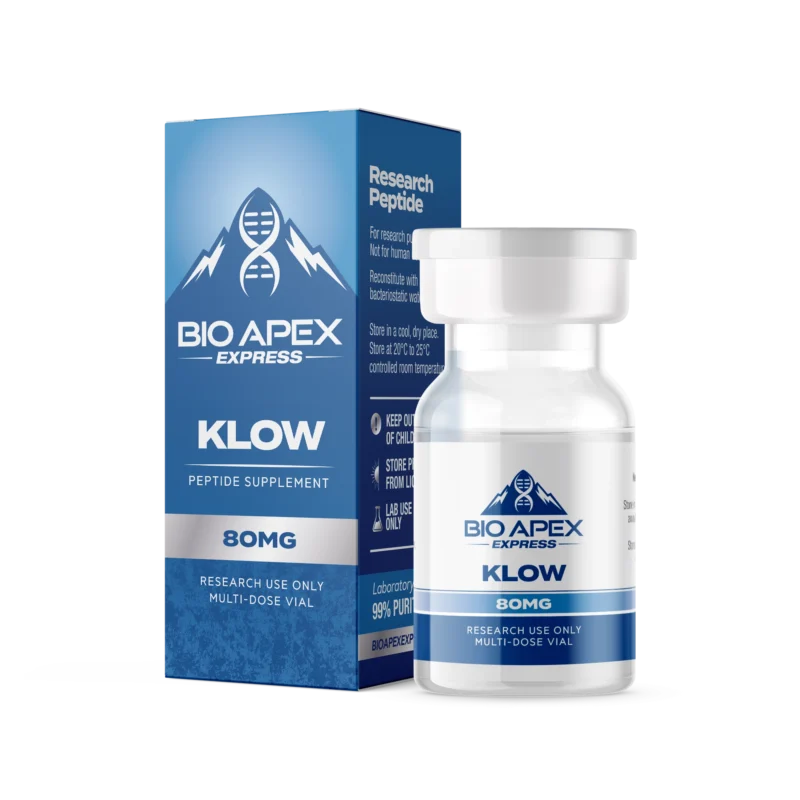
Despite the name, KLOW is not a single peptide. It generally refers to a research blend containing BPC-157, GHK-Cu, TB-500, and KPV. Different suppliers may use different concentrations or ratios, so “KLOW” should not be treated as a standardized pharmaceutical formulation.
The important scientific distinction is that these peptides have largely been investigated individually. There is currently no controlled clinical study demonstrating the safety or effectiveness of the four-component KLOW combination itself.
This article provides an educational overview of what each component is, why researchers are interested in them, and where the evidence remains limited.
What Is the KLOW Peptide Blend?
KLOW is commonly described as a four-component peptide formulation consisting of:
GHK-Cu + BPC-157 + TB-500 + KPV
A commonly marketed research formulation contains approximately 50 mg GHK-Cu, 10 mg BPC-157, 10 mg TB-500, and 10 mg KPV, for 80 mg total. However, this composition is not universal. Other ratios are marketed, reinforcing that KLOW is a commercial or research designation rather than a standardized drug formulation.
Each component has attracted research interest for a different biological pathway. Broadly, GHK-Cu has been investigated in skin and extracellular-matrix biology, BPC-157 primarily in experimental tissue-repair models, thymosin-beta-related peptides in cell migration and wound biology, and KPV in inflammatory signaling.
The rationale behind combining them is therefore based largely on their individual research profiles, rather than evidence demonstrating that the combination produces additive or synergistic effects.
BPC-157: The Tissue-Repair Research Component
BPC-157 is a synthetic 15-amino-acid peptide that has received considerable attention in experimental research.
Much of the interest surrounding BPC-157 comes from animal studies investigating tissues such as tendons, ligaments, muscle, gastrointestinal tissue, and blood vessels.
Experimental research has examined potential interactions with pathways involved in:
- Angiogenesis and blood-vessel signaling
- Nitric oxide regulation
- Cellular migration
- Tendon and ligament healing
- Gastrointestinal tissue protection
Animal studies have produced interesting findings, particularly in models of tissue injury. However, the human evidence base remains extremely limited. This is an important distinction because results from rodent or laboratory models cannot automatically be assumed to occur in humans.
GHK-Cu: The Copper Peptide
GHK-Cu (glycyl-L-histidyl-L-lysine copper) is quite different from BPC-157.
It is a naturally occurring copper-binding tripeptide that has been investigated for decades, particularly in relation to skin and connective-tissue biology.
Researchers have explored GHK-Cu for its potential influence on:
- Collagen synthesis
- Elastin production
- Fibroblast activity
- Extracellular-matrix remodeling
- Wound-healing processes
- Hair-follicle biology
- Inflammatory and antioxidant pathways
Because of this research history, copper peptides have also become common ingredients in cosmetic skincare formulations.
The presence of GHK-Cu is one reason KLOW is sometimes discussed in relation to skin and regenerative research. However, evidence concerning GHK-Cu individually should not be interpreted as evidence that the complete KLOW formulation produces the same effects.

TB-500: Cell Migration and Tissue Research
TB-500 is commonly discussed in connection with thymosin beta-4 biology.
Thymosin beta-4 is a naturally occurring peptide involved in several cellular processes, particularly actin regulation and cell migration. These processes are important during tissue remodeling and wound repair.
Research related to thymosin beta-4 has investigated:
- Cell migration
- Formation of new blood vessels
- Wound closure
- Tissue remodeling
- Inflammatory signaling
However, terminology surrounding TB-500 peptide can become confusing because commercial products described as “TB-500” are not always equivalent to the full naturally occurring thymosin beta-4 molecule.
For this reason, findings involving thymosin beta-4 should not automatically be attributed to every product marketed as TB-500.
KPV: The Inflammation-Research Component
KPV is a very small peptide consisting of three amino acids: lysine, proline, and valine.
It corresponds to the C-terminal portion of alpha-melanocyte-stimulating hormone (α-MSH) and has attracted research interest primarily because of potential anti-inflammatory activity.
Experimental studies have examined KPV in relation to inflammatory pathways, including NF-κB signaling and inflammatory cytokine production.
Research has particularly explored its potential relevance to intestinal and inflammatory models.
As with several other components of KLOW, much of this research remains preclinical rather than being established through large human clinical trials.
Why Are These Peptides Combined?
On paper, the research rationale is relatively straightforward.
Each component has been investigated in a somewhat different area:
BPC-157 → experimental tissue-repair and vascular signaling
GHK-Cu → collagen, extracellular matrix, and skin biology
TB-500 → cell migration and tissue-remodeling pathways
KPV → inflammatory signaling
Combining these areas has led to KLOW being discussed in research communities interested in regeneration, inflammation, connective tissue, and skin biology.
But this is also where scientific caution becomes particularly important.
Studying four compounds separately does not establish how they behave when combined.
Researchers would need controlled studies of the actual formulation to determine whether the compounds complement one another, interfere with one another, alter pharmacokinetics, or introduce unexpected effects.
At present, published evidence for KLOW primarily comes from extrapolating research on its individual components rather than trials of the complete blend.
Is KLOW the Same as BPC-157?
No.
Although BPC-157 is one component of KLOW, the terms should not be used interchangeably.
BPC-157 refers to one specific peptide. KLOW refers to a multi-peptide formulation that typically combines BPC-157 with GHK-Cu, TB-500, and KPV.
This distinction becomes particularly important when reading scientific papers. A study involving BPC-157 alone does not provide evidence for the complete KLOW blend.
KLOW vs. GLOW Peptide Blends
Readers researching peptide blends may also encounter the term GLOW.
These names are not standardized scientific classifications, but GLOW commonly refers to a three-component combination containing:
GHK-Cu + BPC-157 + TB-500
KLOW generally adds KPV to that combination.
Again, formulations can vary by supplier, so the actual ingredient list and analytical documentation are more meaningful than the name printed on a vial.
What Does the Research Actually Support?
This is perhaps the most important question.
There is considerably more scientific literature examining the individual components than there is research examining KLOW itself.
The evidence also varies significantly between components and proposed applications. Some findings come from laboratory cell experiments, others from animal models, and only limited areas have meaningful human clinical evidence.
Therefore, claims that KLOW has been “proven” to accelerate recovery, regenerate tissue, reduce systemic inflammation, improve skin, or produce other whole-body effects go beyond what controlled research on the blend currently demonstrates.
The scientifically appropriate conclusion is that KLOW combines several biologically interesting research peptides, but the combination itself remains insufficiently studied.
KLOW Peptide in Canada
For people researching KLOW peptide Canada, the regulatory distinction is important.
Health Canada specifically warns about unauthorized peptide products sold online, including products labelled “For Research Use Only – Not for Human Consumption.” Its current guidance specifically identifies BPC-157, TB-500, and GHK-Cu among peptide substances appearing in unauthorized products and notes that research-use labeling does not exempt products from Canadian regulatory requirements.
Accordingly, research products should not be confused with Health Canada-authorized therapeutic products.
Safety and Research Limitations
Assessing the safety of KLOW presents the same problem as assessing its effectiveness: the complete combination has not been adequately studied in controlled human trials.
Each component has its own pharmacology, experimental evidence, and potential risks. Combining several compounds creates additional uncertainties surrounding interactions, exposure, stability, and longer-term effects.
Product quality introduces another variable. Peptides obtained outside regulated pharmaceutical channels may differ in identity, purity, sterility, concentration, or contamination risk.
These uncertainties are particularly relevant when laboratory compounds are discussed online as though they were established therapies.
Common Misconceptions About KLOW
“KLOW is just another name for BPC-157.”
No. BPC-157 is typically one of four components.
“All four peptides are clinically proven.”
No. Evidence varies substantially among the components, and much of it is preclinical.
“If each peptide has research behind it, the combination must work better.”
That conclusion cannot be made without studying the combination itself.
“Research use only means it is approved for personal use.”
No. In Canada, Health Canada specifically states that this type of labeling does not make unauthorized peptide products exempt from regulatory requirements.
What Researchers Still Need to Determine
There are several major unanswered questions surrounding KLOW.
Controlled research would be needed to establish the pharmacology of the combination, potential interactions among its components, appropriate exposure levels, short- and long-term safety, and whether combining the peptides actually provides advantages over studying individual compounds.
Most importantly, human clinical trials would be required before claims about therapeutic effectiveness could be established.
Final Thoughts
The KLOW peptide blend is an interesting example of how modern peptide research is increasingly moving from individual compounds toward multi-component formulations.
Typically combining BPC-157, GHK-Cu, TB-500, and KPV, KLOW brings together peptides that have independently attracted research interest in tissue repair, extracellular-matrix biology, cell migration, and inflammatory signaling.
But there is an important gap between the research surrounding the individual ingredients and the evidence surrounding the finished blend.
At present, KLOW itself has not been validated through controlled clinical trials, and evidence from studies of BPC-157, GHK-Cu, TB-500, or KPV individually should not automatically be interpreted as evidence for the combination.
For anyone following peptide science, KLOW is therefore best viewed as an emerging research formulation rather than an established therapy—one whose individual components provide interesting areas of investigation, but whose combined effects remain an open scientific question.
